AWS Imagine Nonprofit 2026: Notes and Takeaways
Notes from AWS Imagine for Nonprofits 2026. AI governance rooted in mission values, the Jane Goodall Institute's document processing pipeline, and getting AI into workflows.
This was my second year at AWS Imagine. Last year, Jane Goodall herself was the keynote. The 2026 event marked the 10th anniversary, and the room was full of nonprofit technologists from different sectors who share something fundamental: they are centering mission, and they are using technology as a means to change the world for the better.
An event like this can work on three levels: you get humbled by fully-realized projects changing lives at a global scale. You get inspired when you feel the potential of your own work. And you learn details from related solutions that can take home to your work tomorrow. I felt all three last year and that’s what brought me back.
Keynote
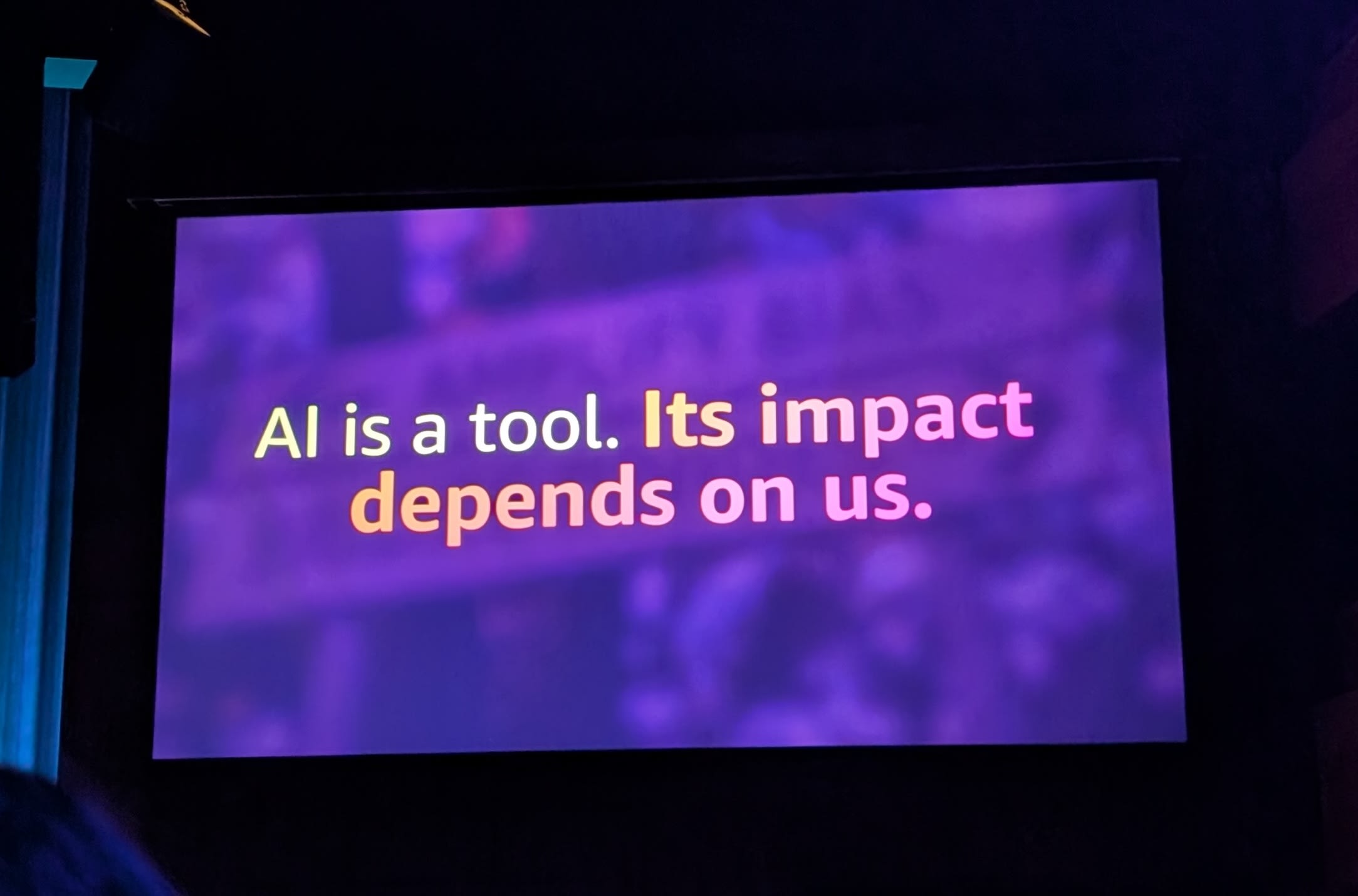
The keynote opened with Lauren Stovall, Global Head of Nonprofit Programs at AWS, framing the day around a line that stayed with me: “AI is a tool. Its impact depends on us.” Couldn’t agree more.
Dr. Lilian Pintea, VP of Conservation Science at the Jane Goodall Institute, shared updates on satellite imagery for advocacy and an audio-based species identification project where a one-minute recording from Gombe identified six known species and one previously unclassified bushbaby call. Incredible. He also flagged digital archives work that would get a build session later in the afternoon. My ears perked up (more on that below).
Felipe Arango, CEO of Fair Trade USA, presented on using AI to strengthen transparency between consumers and producers. Inspiring work, centered on the people the technology serves.
John Legend closed the keynote in a fireside chat with Dave Levy. They showed his high school essay, written as a teenager, about making an impact on Black history. Refreshing to see a superstar like Legend have such an early interest in community leadership and philanthropy.
Jane Goodall Institute: intelligent document processing
The standout session of the day. The morning keynote referenced this at a high level, but the afternoon build session with Xi Palazzolo, Senior Deep Learning Architect at AWS, went into the technical implementation.
Xi walked through how the Jane Goodall Institute is using intelligent document processing to make decades of field research notes from Gombe accessible. The challenges: handwriting that varies across researchers (some nearly illegible even to humans), domain-specific shorthands, ambiguous timestamps, and translation from Swahili and the Gombe dialect into English with no LLM specifically trained on Swahili.
Their approach leaned on prompting techniques rather than retraining models: in-context learning, visual language models (Qwen V7 on Amazon Bedrock) for handwriting recognition, and few-shot prompting for domain logic like timestamp interpretation. Scanned documents in, structured JSON out, stored in DynamoDB. Ten seconds to about a minute per document.
This wasn’t just infrastructure running behind the scenes in Bedrock. They had a polished review interface: original field notes on the left, extracted data on the right, with confidence scores for each translation. Reviewers edit, confirm, or deny before anything enters the database. Field researchers who previously waited weeks for translated data now get it in minutes. Clear human in the loop design.
The pipeline shape is similar to what I’m working on with program book archives at the BSO, but this is an advanced, production-ready application. We’re at a proof of concept stage. Inspiring to see this mature version having impact. And great to have an opportunity to talk briefly with Xi about our approach afterwards.
Executive roundtable: from AI experimentation to mission impact
An invite-only roundtable in the afternoon covered AI measurement, building AI capabilities in resource-constrained teams, and responsible governance.
Jeffrey Collins from Compassion International opened the session with their work using machine learning to protect children in sponsorship programs, including screening communications for grooming language. Impressive engineering and real impact. (He has presented the technical detail at AWS re:Invent 2024.)
What stuck with me, though, was the conversation about values. When Compassion International built their AI governance framework, they started from their mission. As a Christian organization, their AI values are grounded in the Beatitudes. That’s specific to them. But the principle is universal: before the policies and the technical guardrails, there’s a conversation about what this technology is for at your organization. Some governance is table stakes regardless of who you are: PII handling, data security, user access control, keeping data out of training sets. But the values layer has to come from mission. And that shouldn’t be the hard part. Our values are already our values. They just need to be articulated in this context.
What I’m sitting with
Two ideas are resonating with me in the days after this event.
The first: AI has to be in the workflows, where people are working, not just in the hands of a few technical experts. If these tools can make everyone incrementally more efficient and effective, then in aggregate they’ll be transformational. (This was also a strong theme at Snowflake Data for Breakfast ten days earlier.)
The second: we are not going to have all the governance figured out before we start. We need enough to feel confident the foundational guardrails are covered, the goals are clear, and then get people working. The rest gets defined as we go.
Two events in ten days with strong signals we’re on the right path. Just need to keep moving.